If the first things to come to mind when you think of fantasy are treks across unknown realms, sword-swinging heroes, and soaring dragons, you’re probably a fan of this side of the fantasy coin (the other side being low fantasy).
Encompassing some of the oldest and most famous examples of fantasy literature, high fantasy takes us on a journey to realms wholly of the imagination, which act as a playground for almost limitless storytelling possibilities.
While heroic quests are the mainstay of the genre, everything from teenage romances to murder mysteries to global wars involving the gods themselves can be found under this broad umbrella of fantasy fiction.
What is High Fantasy?
High fantasy is a sub-genre of fantasy literature which takes place entirely in a secondary world setting—a setting wholly separate from our reality. Whether the story focuses on a single village or an entire planet, it is a place not to be found in our universe. These settings often have their own cosmological and metaphysical rules and are populated by fantastic peoples and creatures. Also, the characters in these stories are native to the setting (refer to portal fantasy for secondary worlds visited by characters from Earth).
The Origin of High Fantasy
While I covered the origin of high fantasy in more detail in both The History of Fantasy Literature and The Fantasy Divide: Low vs High Fantasy, we’ll run through this briefly. The legacy of all fantasy literature can be traced back thousands of years to heroic epics like The Epic of Gilgamesh and The Iliad. Much of the inspiration for high fantasy also came from the folklore and fairy tales that grew over time in ancient and middle-ages Europe, which were then retold and reimagined as fiction in the Victorian era.
Notable from this time is The Well at the World’s End by William Morris, published in England in 1896. Inspired by fairy tales, this novel about a young knight’s quest to find a magic well is set in a fictional land reminiscent of medieval Europe. It is considered by many to be the first example of a secondary world, and a prototype for high fantasy.
In 1937, J.R.R. Tolkien published The Hobbit, or There and Back Again, set in a fictional world called Middle-Earth. Unlike the limited scope of its predecessor, this book shows us an entire world with fantastic people and creatures, varied cultures, magic, and hints of a rich history. Most agree this was the first high fantasy novel. Tolkien expanded on this world in The Lord of the Rings trilogy in the 1950s.
Despite this, the genre wouldn’t get a name for over forty years. For a long time, fantasy was just fantasy. The possible first use of the term “high fantasy” was in an essay by Lloyd Alexander, first presented to the New England Round Table of Children’s Librarians in 1969 and later published as “High Fantasy and Heroic Romance” in 1971.
Elements of High Fantasy
When we delve into a work of high fantasy, we have many expectations. Of course, the defining factor of a secondary world setting is chief among these, but we might anticipate this world will be full of magic and fantastic creatures. Wizards, dragons, elves, and heroic warriors wielding enchanted swords are all things one may find in high fantasy.
Elements that can be found in high fantasy literature, other than the prerequisite secondary world, include:
- Fantasy species like elves, dwarves, halflings, orcs, and goblins.
- Fantastic creatures and monsters, such as dragons, hydra, trolls, vampires, and zombies.
- The existence of magic, which can range from rare to commonplace.
- Supernatural and/or divine beings, who might even play active roles in a story.
- A pre-industrial setting, with medieval European influences being most common.
None of these things, of course, are definitive of high fantasy. The secondary world setting is the only defining element—anything beyond that can be included in varying degrees. When writing high fantasy, the author makes the rules of their setting. You might have a world without magic but populated by elves and dwarves, or one peopled only by humans but full of magic. The technology level can range from the stone age to a modern equivalent, though the latter is exceptionally rare (for futuristic fantasy, refer to science fantasy). Since most high fantasy is also medievalist fantasy, stories inspired by other historical eras generally illicit a further sub-subgenre label, notably stonepunk, sandalpunk, flintlock fantasy, and gaslamp fantasy.
Also typical of high fantasy is some sort of journey into the unknown or heroic quest, with the hero’s journey being a very common plot structure in the genre. However, there are all kinds of tales to be told in a high fantasy setting. Romances, murder mysteries, heists, and treasure hunts are but a few examples that break away from the typical heroic quest.
Finally, high fantasy stories often contain dominant themes of good versus evil, and while there is definitely room for shades of gray, things in this subgenre are often very black and white when it comes to questions of morality. In fact, delving into morally grey areas is considered such a departure from the norm that it generally will shelve a tale into a sub-subgenre of high fantasy, such as grimdark fantasy or sword & sorcery.
Examples of High Fantasy
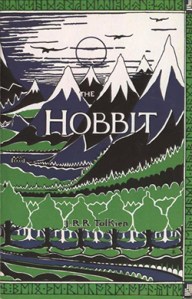
The Hobbit by J.R.R. Tolkien (1937)
As mentioned above, The Hobbit is considered by most to be the book that created the genre of high fantasy. The world of Middle-Earth is a vast setting peopled by humans, elves, dwarves, hobbits, orcs, trolls, and dragons. Wizards travel the landscape, either bending the events of the world to their will or fighting to protect the status quo. Magic, while not an everyday part of life, plays a huge role in pivotal events.

The Book of Three by Lloyd Alexander (1964)
Written by the man who may have coined the term “high fantasy”, The Book of Three is the first of The Chronicles of Prydain pentalogy. The setting of the books is the fictional land of Prydain, consisting of several small kingdoms lorded over by a high king. The realm is inspired by Wales, and elements of Welsh mythology and folklore are present in the worldbuilding of the series, including elves, dwarves, the undead, and magic.
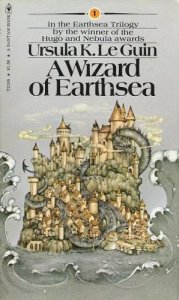
A Wizard of Earthsea by Ursula K. Le Guin (1968)
A classic example of high fantasy, A Wizard of Earthsea follows a young student of magic across an archipelago world in a quest to free himself from an ominous threat. The world of Earthsea is filled with magic and populated by dragons and various cultures of humans. Notably, this book first introduced the idea of a wizard school, which would become a prominent feature of some settings in the future, like the Forgotten Realms, and the focal point of the Harry Potter series.
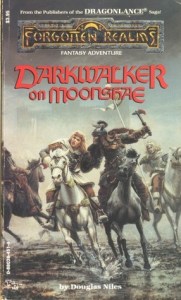
Darkwalker on Moonshae by Douglas Niles (1987)
A personal favorite of mine, Darkwalker on Moonshae is notable for being the first novel set in the Forgotten Realms setting created by Ed Greenwood for the Dungeons & Dragons tabletop roleplaying game (TTRPG), arguably the largest and most intricately detailed fantasy world ever created. This is still the primary world for the TTRPG and is the setting for one film, a handful of board games, about forty video games, and around three hundred books!
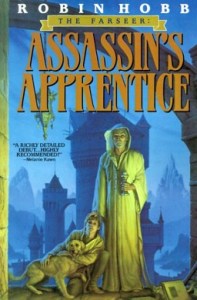
Assassin’s Apprentice by Robin Hobb (1995)
The first of The Farseer Trilogy, The Assassin’s Apprentice establishes a fantasy world full of political intrigue with a well-thought-out magic system. The novel follows the tale of a young boy with the power to telepathically communicate with animals. Though he is first put to work as a stable hand, he is later trained as an assassin and set to work for the king. This book has been highly praised by both media outlets like Publisher’s Weekly and authors like George R.R. Martin.
Epic Fantasy
When you pick up an epic fantasy novel, you usually know what you have in your hands before you even crack it open. It is probably going to be big and heavy. If you look on the shelf, there might be two, ten, or dozens more volumes after the first!
Epic fantasy is one of those subgenres of speculative fiction that does exactly what it says on the tin: it is epic. A broad scope and massive scale are the defining features of this genre. Epic fantasy presents a conflict on a large scale with nation- or world-changing consequences to its outcome. You’ll often see entire armies clashing, or the hero must succeed in their quest to prevent something catastrophic from befalling a large population. This doesn’t have to be end of the world kind of stuff, although it often is, as these consequences could also involve preventing something like the conquest of a nation. On the other hand, perhaps the protagonist is the one doing the conquering.
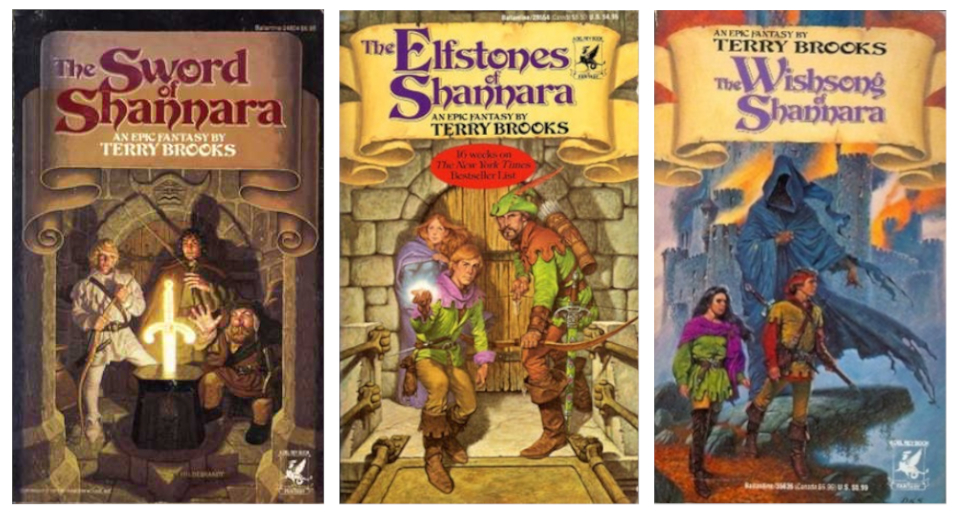
The origins of this genre lie parallel to those of high fantasy, with Tolkien’s The Lord of the Rings trilogy setting the stage for these world-spanning, epic battles for the fate of the realm. The genre was further cemented with the release of The Sword of Shannara by Terry Brooks in 1977, the commercial success of which proved there was a market thirsty for more of the kind. This may also be the first official use of the term epic fantasy, as “an epic fantasy” appears both on the first edition hardcover dust jacket and the cover of the first edition paperback. The term clearly hearkens back to the epic poems and tales of old, such as The Epic of Gilgamesh and Homer’s The Iliad. Hence, it may have wormed its way into the popular lexicon before Brooks’ publisher put it on the cover.
Elements of Epic Fantasy
There are elements of epic fantasy that make it what it is, and others that one expects to see but are not definitive of the genre. As defined above, what makes a story epic fantasy are two things: the scale and the consequences. Epic fantasy deals with events spanning entire nations, an entire world, or an entire universe. The consequences are also impersonal—the very fate of the world may be decided within these prodigious volumes. The outcome of the story will potentially affect entire populations, not just the main characters.
Other features of epic fantasy aren’t necessary elements to include, but often arise due to the scale of the conflict. The most obvious of these is the presence of massive armies. We see them on the march and in pitched battles between thousands of warriors. Even if armies and battles are not the focus of the book, they might serve as part of the background to illustrate the scope of the conflict. Another common feature is the “dark lord”. Often, the primary antagonist in epic fantasy is the ruler of a realm or some dark force bent on world domination (or destruction). Finally, one often sees a “fellowship”—to borrow from Tolkien—present in epic fantasy: a large cast of diverse protagonists set on identical, parallel, or converging paths with a common goal.
Examples of Epic Fantasy
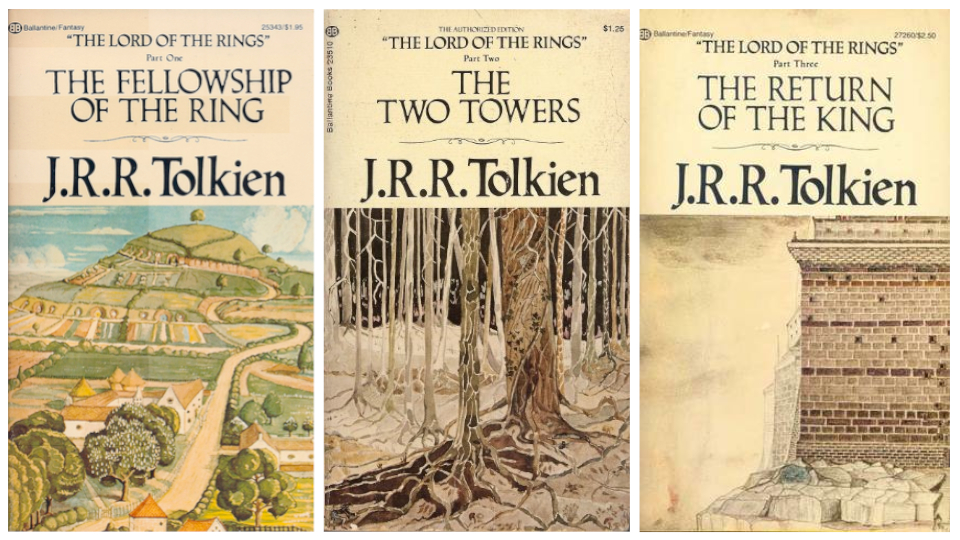
The Lord of the Rings trilogy by J.R.R. Tolkien (1954 – 1955)
As mentioned, this was the first fantasy series to go epic. If Frodo doesn’t keep the one ring from the grasp of Sauron, the dark lord will conquer all of Middle-Earth and plunge it into a time of darkness. Since the publication of The Lord of the Rings trilogy, J.R.R. Tolkien and his son Christopher have expanded on the lore with books like The Silmarillion (1977) and the twelve-volume The History of Middle-Earth series (1983 – 1996).
The Shannara Chronicles by Terry Brooks (1977 – 2020)
When Terry Brooks published The Sword of Shannara in 1977, he cemented the genre of epic fantasy as an enduring part of the fantasy literature landscape. Each book in the original trilogy follows different heroes facing different threats to their world. Since then, others have taken up the heroic mantle. Brooks concluded the series in 2020 with the publication of The Last Druid, wrapping up a saga spanning twenty-nine books and forty-three years of writing!
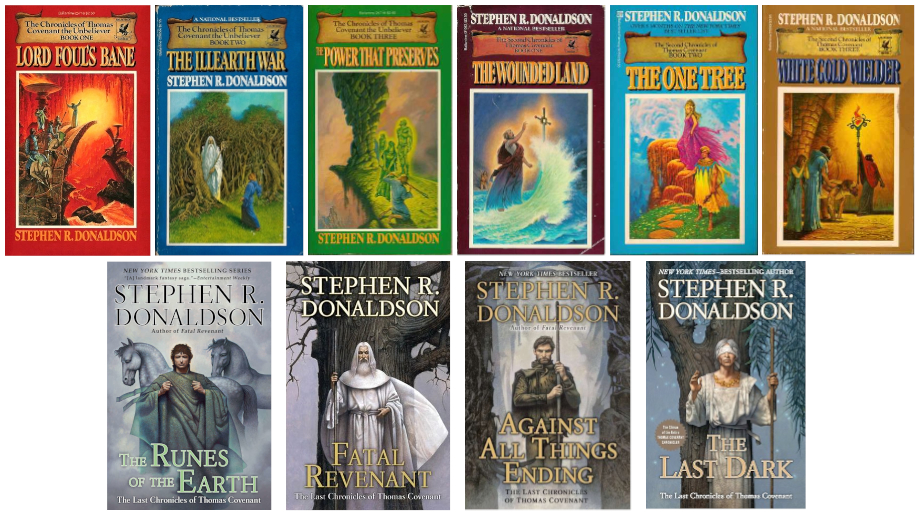
The Chronicles of Thomas Covenant by Stephen R. Donaldson (1977 – 2013)
Published in the same year as our prior entry, Lord Foul’s Bane by Stephen R. Donaldson kicked off this ten-book series that deserves a share of credit with Brooks’ work for establishing the genre of epic fantasy. The series follows the tale of the titular protagonist as he works against the evil machinations of Lord Foul. The first three books were published as a trilogy, The Chronicles of Thomas Covenant the Unbeliever, with The Second Chronicles of Thomas Covenant trilogy following on its heels. Donaldson returned to Thomas’s story after a twenty-year gap to complete the series with a tetralogy, The Last Chronicles of Thomas Covenant.
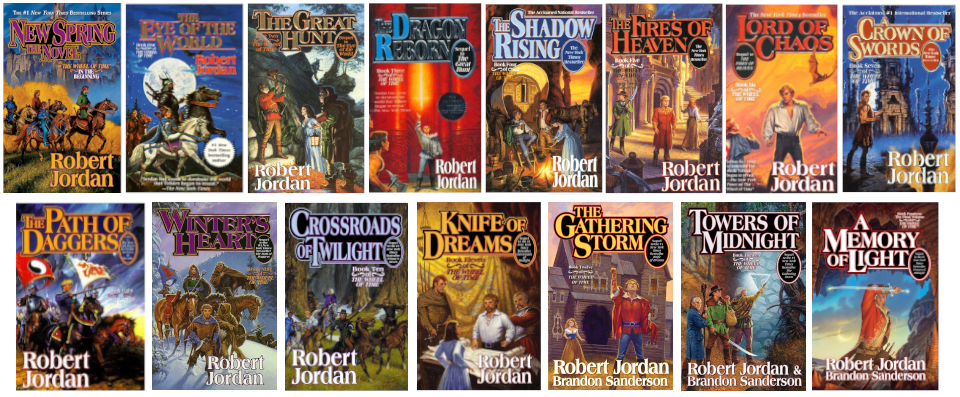
The Wheel of Time by Robert Jordan with Brandon Sanderson (1990 – 2013)
When it comes to epic fantasy, the first thing that comes to mind for many is The Wheel of Time by Robert Jordan. Sadly, Jordan passed away before he could complete the series, but he left copious notes for his family should he be unable to finish his work. His widow, Harriet McDougal, chose to pass the torch to Brandon Sanderson, who completed the final three novels. This series is about as epic as they get, with the protagonist struggling to prevent a dark lord from ending the world, but with the twist that in doing so, he might end the world himself. This massive saga weighs in at fourteen books, around twelve thousand paperback pages, and just shy of four-and-a-half million words!
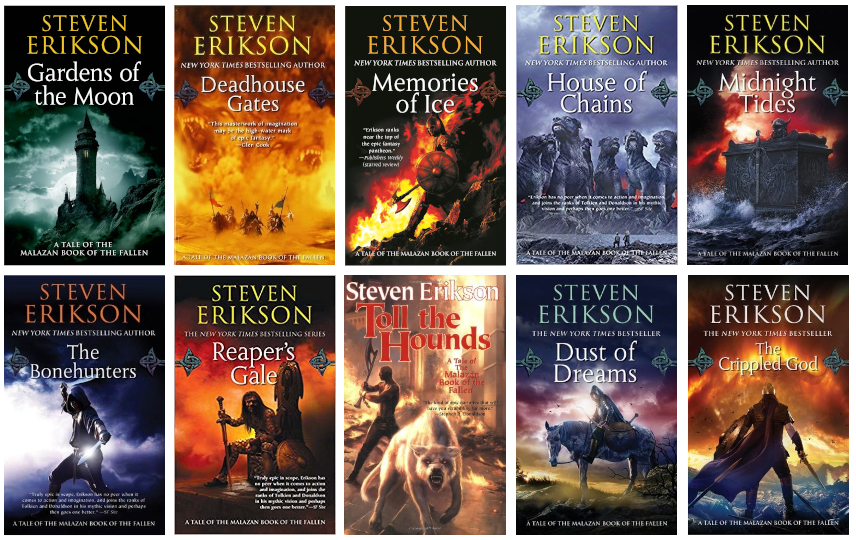
Malazan Book of the Fallen by Steven Erikson (1999 – Ongoing)
This dark, gritty series spans ages and continents as powerful nations wage war over the fate of the world. It’s hard to weigh up against our prior example, but with ten books, over seven thousand paperback pages, and over three million words, the core series of the Malazan Book of the Fallen comes close. If you add in prequels and spin-offs written by both Erikson and Ian Cameron Esslemont, you’re looking at twenty-three novels weighing in at a whopping five-point-eight million words, with more books in the works and not even counting a series of seven novellas. Many cite this as being the longest epic fantasy series in existence.
Epic Fantasy vs High Fantasy
Epic fantasy and high fantasy almost always go hand-in-hand, but it is important to remember that epic fantasy is not synonymous with high fantasy. While most* epic fantasy is high fantasy, not all high fantasy is epic fantasy. A lot of sources will use the terms interchangeably, but as we can see from our definitions of high and epic fantasy, there are distinct characteristics that define each. In review: high fantasy stories are set on a secondary world with characters native to that world while epic fantasy stories present large-scale conflict and consequences.
*I say most because, when discussing genres, there are almost always exceptions to the rule. It is entirely plausible for an author to pen a low fantasy story with an epic scale. However, this is something that is relatively rare.
It is important to remember that while the two labels may not be synonymous, that does not mean that they are not compatible. As discussed, most epic fantasy is also high fantasy, with The Lord of the Rings trilogy being one of the first examples of both. They are neither mutually exclusive nor mutually inclusive.
So, why are they so often conflated? The most likely reasons these terms are used interchangeably at times is because almost all epic fantasy is also high fantasy, and arguably the most popular high fantasy books are also epic fantasy. Also, there are a lot of books out there that are both high fantasy and epic fantasy. Rather than being a rule or feature of the genres, the blending of the two terms likely results from the impact of this popular convergence.
Heroic Fantasy
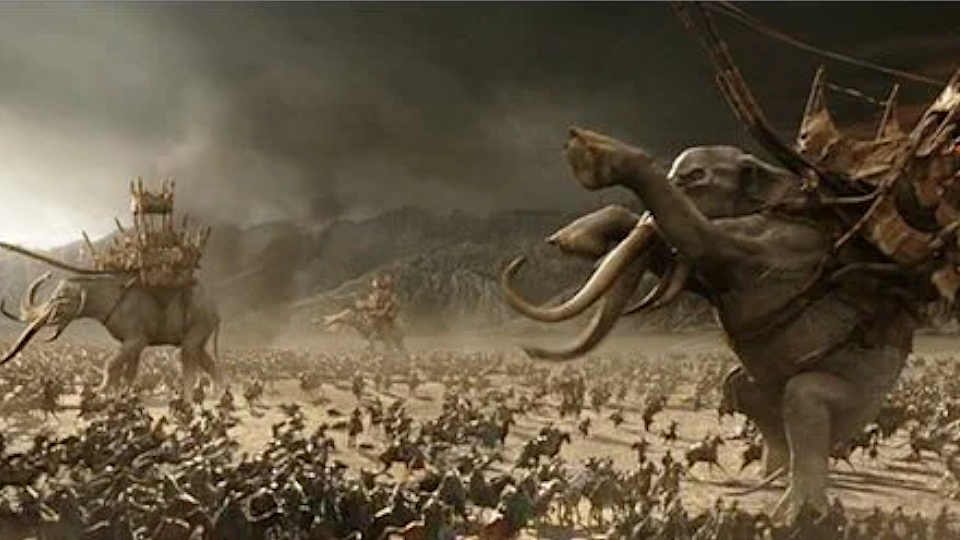
While epic fantasy involves huge casts and world-shaking events, heroic fantasy focuses on fewer characters and more personal-scale narratives. However, there is some room for overlap between the two. A story that starts mostly small might end up having epic consequences, or it might reside within an entire range of scale between the two extremes.
Importantly, heroic fantasy focuses on the hero’s journey and features protagonists who are inarguably the good guys. No grim antiheroes here. Also, it always involves a secondary world setting, which normally won’t be dark or gritty. It can be realistic and show problems in the world, but the atmosphere should be generally optimistic. Finally, the plot is usually simple and packed with action. The story may be character-driven, with a focus on the protagonist’s arc, or it could be totally plot-driven, such as with a serial hero saving the day before riding into the sunset to seek their next adventure.
We can thus say that heroic fantasy is a subgenre of high fantasy with a focus on a small group of morally good characters facing straightforward challenges of limited scope in a world that has a mostly positive atmosphere. Or, as written in the introduction to the 1967 edition of Conan by Robert E. Howard, L. Sprague de Camp, and Lin Carter:
“[Heroic fantasy] is escape fiction wherein one escapes clear out of the real world into one where all men are strong, all women beautiful, all life adventurous, and all problems simple…”
L. Sprague de Camp
When de Camp wrote that, he also mentioned sword & sorcery, but used the terms synonymously. Over time, the two have grown to encompass related, sometimes overlapping, but often distinct subgenres of fantasy, which we will compare and contrast below. Ironically, from the current perspective on the genres, the very book this quote is from is better defined as sword & sorcery. The quote still works to describe both genres, but I think it is more on the nose here.
Elements of Heroic Fantasy
While the definition of heroic fantasy leaves a lot of wiggle room for different interpretations—including approaches to plot, characterization, setting, and theme—there are some similarities that will pop up more often than not in these stories.
A Hero Worth Rooting For
The focus of the heroic fantasy is often on a singular protagonist, though having a strong ensemble is not out of the question. Often of humble origin, our hero or heroes will step up in a time of need to overcome challenges they never expected to face. Sometimes, the protagonist might be a local folk hero—a Robin Hood of sorts. Either way, they do not act for their own self-interest, but instead because of a moral imperative. (Note that this moral idealism is one of the most important defining characteristics of heroic fantasy.) The protagonist’s character arc might be a central focus of the story, so heroic fantasy can often be a very character-driven narrative. However, a pulpier monster-of-the-week approach works here as well, especially with the aforementioned folk hero.
A Place Worth Fighting For
While the wider world might have its share of problems, the focus of the heroic fantasy story will often be on a small slice of the landscape that might be a nice place to live. It could be an idyllic countryside or a sleepy village. The people who live there are generally kind and cooperative, and they’re just going about making a living for themselves, perhaps tilling the soil or working a craft. The most iconic example of this would be The Shire from Tolkien’s Middle-Earth. From here, the story might take us on a journey, but unlike the continent-spanning travels of epic fantasy, this is usually something more localized. Also, heroic fantasy usually sticks to being set in a pre-industrial world.
A Simple Conflict
In the end, our hero will often resort to wielding steel to solve most problems. The conflicts in heroic fantasy are usually small in scope: The danger is immediate, and the threat is to the protagonist, their loved ones, or a small populace. The problems are also relatively simple to solve. While there might be a difficult journey full of traps, mysteries, and foes aplenty, we aren’t usually going to be dealing with multi-national politics or the meddling of fickle gods. Rather, there is often a clear “bad guy” to take out, perhaps a neighboring baron abusing his power, an evil wizard abducting the village’s children for his vile experiments, or a personal nemesis of the protagonist.
Examples of Heroic Fantasy
Imaro (1981) by Charles Saunders
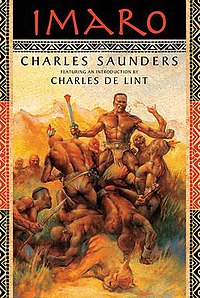
In this fantasy world inspired by African culture and myth, the titular hero struggles to find acceptance among his people, eventually roaming the land to face enemies of man, beast, and the supernatural. He is hunted until he turns the tides and becomes the hunter. Actually a collection of five short stories, this book is a great example of a monster-of-the-week folk hero, but also features a strong overall narrative with a deep character arc for the protagonist.

The Highwayman (2004) by R.A. Salvatore
Though some subject matter in the novel is a bit dark, The Highwayman remains a great modern example of heroic fantasy character. Bransen, the protagonist of the novel, faces a troubled existence as a disabled boy bullied by those around him. However, when he discovers a way to overcome his disability, he fights back against all those who bully the weak, robs from tax collectors, gives money to the poor, and saves those he cares most about. Bransen’s story continues in The Ancient (2004), The Dame (2009), and The Bear (2010).
The Name of the Wind (2007) by Patrick Rothfuss
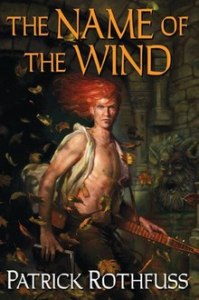
In this first book of The Kingkiller Chronicles trilogy, an innkeeper in a small town saves a travelling sage and is revealed to be Kvothe, a famous swordsman, magician, and musician who’s been in hiding. The sage asks him to recount his story, setting up the premise of the trilogy. In the first book, Kvothe recounts his troubled childhood and how he attended a university to study magic and learn more about the denizens of the fae realms.
Sword & Sorcery
Sword and sorcery is like the cynical brother of heroic fantasy. They both involve a limited scope and scale with a simple plot set in a pre-industrial fantasy world. The main differences between them are that the setting is generally darker and the protagonist(s) often act on selfish rather than idealistic motivations. These stories might involve stealing a ruby from a wizard’s tower or defeating some monster for the treasure in its lair. Sword & sorcery and heroic fantasy have a lot in common though, and it is possible for them to overlap, but we will dive further into these distinctions shortly.
In contrast to heroic fantasy, we can say sword & sorcery is a subgenre of high fantasy with a focus on a small group of morally questionable or selfish characters facing straightforward challenges of limited scope in a grim and gritty world.
The term sword & sorcery was coined by Fritz Leiber in 1961 in response to a letter from British author Michael Moorcock, which sought to define the type of fantasy adventure stories told by American author Robert E. Howard, creator of Kull of Atlantis and Conan the Barbarian. Leiber’s answer appeared in the July 1961 issue of Amra, a science fiction and fantasy fanzine:
I feel more certain than ever that this field should be called the sword-and-sorcery story. This accurately describes the points of culture-level and supernatural element, and also immediately distinguishes it from the cloak-and-sword (historical adventure) story — and (quite incidentally) from the cloak-and-dagger (international espionage) story too!
Fritz Leiber
Elements of Sword & Sorcery
Like heroic fantasy, sword & sorcery can be distinguished by a straightforward plot and a limited scope and scale to the conflicts and consequences. Also, as the name implies, these stories will be in a pre-industrial setting (sword) and feature some significant magical elements (& sorcery). In addition to all this, there are a few more distinguishing elements of this subgenre.
Morally Questionable Protagonists
Sword & sorcery tales feature protagonists who are acting for their own benefit. They need not necessarily be bad people, although antiheroes (those lacking the classic drives of idealism and morality) are common in this genre. Thieves looking only to fill their coin purse is a usual trope, or the protagonist might have some personal dilemma driving them to engage with the plot with a goal of improving their situation. When contrasting sword & sorcery with heroic fantasy, this is a key distinction.
Gritty Settings
The worlds of sword and sorcery stories often range from gritty realism to outright dystopias. This can involve kingdoms ruled by malevolent sorcerer-kings, cities rife with poverty and despair, or lands wracked with plague and famine. Sometimes things aren’t taken this far, instead depicting a realistic view of a dark age or medieval society where every day might be full of toil and the common people have few liberties or luxuries.
Brutally Violent Action
While just about any subgenre of fantasy can have a plot-driven, action-heavy narrative, these kinds of stories are dominant in sword & sorcery. Further, this subgenre often takes things to the next level and depicts brutal, highly detailed acts of violence. While not a necessary element, it is more likely than not to appear. Some sword & sorcery stories will use a slow burn approach, building tension toward a violent climax, while others use this sort of action as a prominent feature throughout the narrative.
Examples of Sword & Sorcery
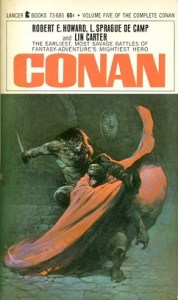
Conan by Robert E. Howard, L. Sprague de Camp, and Lin Carter (1967)
First appearing in “People of the Dark” (1931), published in Strange Tales of Mystery and Terror, Conan featured in his own story for the first time in “The Phoenix on the Sword” (1932), published in Weird Tales. The stories of this violent barbarian—sometimes thief and sometimes conqueror—established the genre of sword & sorcery. This collection from 1967 is the first of a trilogy that assembles all of Howard’s short stories featuring Conan, with de Camp and Carter finishing some uncompleted stories and scribing some new ones.

Swords and Deviltry by Fritz Leiber (1970)
While Howard may have created sword & sorcery, Fritz Leiber both named it and wrote a series of his own stories further expanding on the genre. First appearing in “Two Sought Adventure”, published in Unknown magazine in 1939, Leiber’s stories of Fafhrd and the Gray Mouser would go on to fill this and six other volumes. The paired protagonists were Leiber’s attempt to present more down-to-Earth characters than the over-the-top Conan. While Fafhrd is a sword-swinging barbarian like his predecessor, the Gray Mouser presents an interesting foil as a smaller, nimble thief with a touch of magical knowhow.
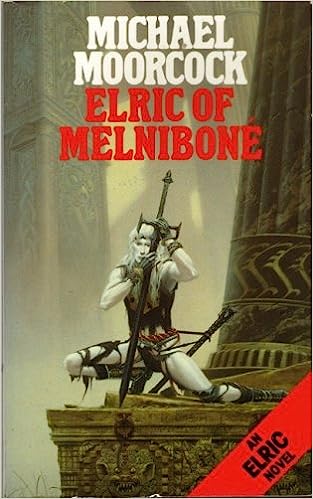
Elric of Melniboné by Michael Moorcock (1972)
Another serial character appearing in pulp magazines, Moorcock’s drug-dependent swordsman-sorcerer Elric first appeared in “The Dreaming City”, published in Science Fantasy in 1961. This novelette was joined in the same periodical by five other novelettes and four novellas by 1964. Moorcock also published several short stories featuring this character. Elric of Melniboné is the first novel in the series, featuring Elric’s origin, and was followed by six more novels and several collections of Moorcock’s short fiction. Elric even appeared alongside Conan in issues 14 and 15 of the Marvel comic Conan the Barbarian in 1972.
Sword & Sorcery vs Heroic Fantasy
Because the definitions of sword & sorcery and heroic fantasy share so much in common—pre-industrial high fantasy focused on a small number of characters with a narrow scope of conflict and consequences—the line between them can be blurry. The other complication is that the differences are subjective elements that exist on a sliding scale. Things like morality, tone, and violence aren’t all-or-nothing propositions, and judgments on where these elements fall on a spectrum also depend on the audience’s viewpoints and ideologies.
The Issue of Morality
The difference between a valiant hero fighting to protect the innocent and a self-serving thief seeking only to enrich themselves is clear. However, there is a lot of middle ground between the two. A protagonist’s motivations aren’t always black-and-white, and they can change over the course of a series, a book, or even a short story. Also, morality itself has room for interpretation. A story with a protagonist that takes a pragmatic approach to problems and considers the costs and benefits of their actions—even if those costs include inflicting duress on or allowing harm to others for the greater good—might fall into the fuzzy middle between the two subgenres.
The Issue of Tone
A prosperous village surrounded by flower-laden meadows lies in stark contrast to a slum-filled city ruled by an autocratic lich-king, but a lot of stories take a more balanced and realistic approach to their worldbuilding. Life isn’t all good or bad, and a lot of authors strive to depict realistic settings. Hence, a lot of fantasy worlds feature a more balanced approach that doesn’t always present a light or dark tone. Also, there’s room for interpretation depending on the audience’s worldview. Someone who has never experienced or witnessed economic anxiety might view depictions of rampant poverty as dystopian, while someone who has struggled their entire life just to get by would see this as simply being realistic.
The Issue of Violence
While brutal, graphic violence is more common with sword & sorcery, it’s not unique to this subgenre. Heroic fantasy usually takes a lighter approach to depicting action, but there is no rule that a morally idealistic character can’t unleash a righteous fury that would make even the likes of Conan squeamish. Also, how much violence is “a lot” depends on who you ask. For some, a spatter of blood is a bit much, but others might find a story tame if there aren’t at least a few disembowelments.
The Issue of Blending it All
The prior point brings up an important thing to consider: mixing these elements often defies genre conventions. As mentioned, an idealistic hero can also be brutal. Likewise, the same hero can exist in a gritty setting where his moral fortitude stands out in a world dominated by selfishness and cruelty. On the other hand, an antihero living in an idyllic realm who doesn’t resort to acts of violence to get their way is entirely plausible.
Telling the Difference
I’ve mentioned several times that ideology versus selfishness are central differences between heroic fantasy and sword & sorcery. When in doubt, I would look to the motivations of the protagonist(s) to determine which genre you’re dealing with—are they heroic? Sometimes this will be clear, but there is a lot of room for grey areas. Many great stories make the protagonist struggle with moral dilemmas. Hence, a narrative can easily be considered to be a blend of the two genres or dependent on interpretation. Also keep in mind that these are relatively specific genres, so if a story doesn’t quite fit, you may be looking at the wrong shelf for it. It might simply be high fantasy, or even another sub-subgenre entirely.
Endless Worlds to Explore
Whether a high fantasy story delves into the personal struggles of a single protagonist or explores an entire world through many eyes navigating complicated geopolitical dramas, high fantasy offers us a view of fantastic worlds that can range from being reminiscent of medieval Europe to presenting completely alien and bizarre landscapes. They key thing to remember about high fantasy is that it is defined by being set on a secondary world. Beyond that, this vast genre can include a huge variety of stories bound only by the limits of our imaginations. No matter the approach or which of many subgenres a tale falls under, one thing is for sure with high fantasy: you’re going on an adventure!
In part four of our exploration of fantasy literature, Low Fantasy and its Major Subgenres, we’ll take a similar deep dive into low fantasy and explore the subgenres of portal fantasy, intrusion fantasy, contemporary fantasy, and historical fantasy.
The Complete Guide to Fantasy Literature
- The History of Fantasy Literature
- The Fantasy Divide: Low vs High Fantasy
- High Fantasy and its Major Subgenres
- Low Fantasy and its Major Subgenres
- More Subgenres of Fantasy Literature
 B.K. Bass, Author and Editor