Vampires stalking the streets of New Orleans. Wizard schools hidden away in the English countryside. A private investigator hunting monsters in Chicago. Children passing through a portal to a magical realm.
These are all things that might come to mind when one considers the sweeping genre of low fantasy, an approach to fantasy literature delves into what life on Earth might be like if the fantastic existed or what it would be like for one of us to travel to a fantastic world.
What is Low Fantasy?
Low fantasy is an umbrella genre of fantasy literature that involves stories that are set in or connected to our reality. I like to say it lies on the opposite side of the fantasy coin from high fantasy, which is set in a completely fictional reality, or secondary world. The easiest way to tell if a work is low fantasy is to first ask if the story is set on Earth. If so, it is definitely low fantasy.
Some will stop there, defining low fantasy strictly as stories that take place on Earth. However, if it’s not set on Earth but there are characters from Earth, you’re probably dealing with portal fantasy. Opinions vary on whether this should be included in low fantasy or high fantasy (or be entirely separate), but as I discussed in The Fantasy Divide, I feel portal fantasy doesn’t agree with the definition of high fantasy (existing on an imaginary world separate from ours). Hence, I agree with the camp that shelves portal fantasy under low fantasy.
Opinions and Exceptions: On that note, there are varying opinions when it comes to genre labels and categorizing subgenres. My aim is to be objective where possible and transparent about gray areas or when I’m asserting an opinion. Also, exceptions abound as many books don’t fit neatly on a specific shelf. Genre labels are far from a perfect system and should be considered guideposts instead of a rigid taxonomy.
Origins of Low Fantasy
Since I’ve covered this in detail in The History of Fantasy Literature and The Fantasy Divide: Low vs High Fantasy, we’ll just take a quick look at the history of the genre here. Of course, all fantasy literature can trace its roots to folklore, fables, fairy tales, and even as far back as heroic epics like The Epic of Gilgamesh. Low fantasy has strong ties to these stories since this genre shows fantastic elements encroaching on life as we know it.
Considered the first work of fantasy in the modern sense, Phantastes: A Faerie Romance by Scottish author George MacDonald was published in 1858. A fairy tale for adults, it tells the story of a young man native to Earth who is drawn into a fantastic realm, making this a prototype for portal fantasy.
It is hard to say when fairy tales became low fantasy. During the first half of the twentieth century, fantastic tales became very popular in the pulp fiction magazines. During this time, weird fiction was a term used for stories we might consider either fantasy or horror today, many of which were a bit of both. The transition to low fantasy as we know it was likely a gradual one, but there is a clear point that illustrates a diversion in approaches to fantasy in the 1950s.
Taking inspiration from MacDonald and other predecessors—including his friend and the father of high fantasy, J.R.R. Tolkien—English author C.S. Lewis published The Lion, the Witch, and the Wardrobe in 1950. While Tolkien continued to explore an entirely new world separate from our own, Lewis followed MacDonald in presenting characters native to our world travelling to a realm of fantasy. While the world of Narnia is an entire fictional world, it is connected to Earth. If we accept that low fantasy includes portal fantasy, this might be the first mainstream example of modern low fantasy.
Elements of Low Fantasy
As mentioned, the defining element of low fantasy is having a story set on Earth with fantastic features, or in the case of portal fantasy, characters from Earth visiting a fantastic world. Otherwise, a few of the common elements one might find in low fantasy are:
- Clandestine organizations protecting and passing on the secrets of magic.
- Fantastic creatures secretly living among us, such as vampires, the fae, or werewolves.
- A connection between Earth and some other, magical realm.
- Magic as part of everyday life, changing how we interact with the world.
- Supernatural elements like deities, angels, demons, and spirits.
There are others, of course, but this brief list gets the idea across of what kind of things one might find in low fantasy. How many of these elements might be included in a story vary, but often low fantasy will stick to inserting just one or two things. The idea is usually to take what we are familiar with and see what happens if one tosses a magical wrench into the works, but every once in a while, an author will throw in the entire toolbox.
Low Fantasy vs Horror
While a lot of horror fiction seems like it might fit the definition of low fantasy, being set on Earth with fantastic elements like monsters, ghosts, or vampires, there is an important distinction between the two. While low fantasy might be scary at times, if the main focus of the book is creating a sense of fear or tension, then it’s horror. Low fantasy, on the other hand, is more about exploring what life might be like with these elements or telling another kind of story, like romance or mystery, with a fantastic twist. However, there is some room here for cross-genre blends, and what exactly is “scary” is very subjective. The further back we look, the muddier this distinction is, since books like The Castle of Otranto (1764) by Horace Walpole and Dracula (1897) by Bram Stoker were written long before these labels existed. These books are generally referred to as gothic fiction, which is considered by many to be a point of divergence in fantastic Victorian literature that led to what we know today as horror fiction. Despite that, the fantasy-horror split was long, gradual, and never a total divorce of the two. Much of what appeared in the pulp fiction magazines of the early twentieth century mixed fantasy and horror into what was known at the time as weird fiction, which is another topic entirely and a subgenre of speculative fiction that endures with a niche following today.
Portal Fantasy
On to our troublesome fantasy cousin. Some consider this high fantasy, some low fantasy (which I obviously agree with), and some say it shouldn’t be included in either. That aside, portal fantasy is any fantasy story where characters native to Earth travel by some means to a secondary fantasy world. How much time a story spends on Earth versus the fantasy world, how many trips are made, and how many people travel there all depend on the story. How they get there could be by means of some sort of magical spell or artifact, a literal portal, or even a piece of furniture intended to store coats…
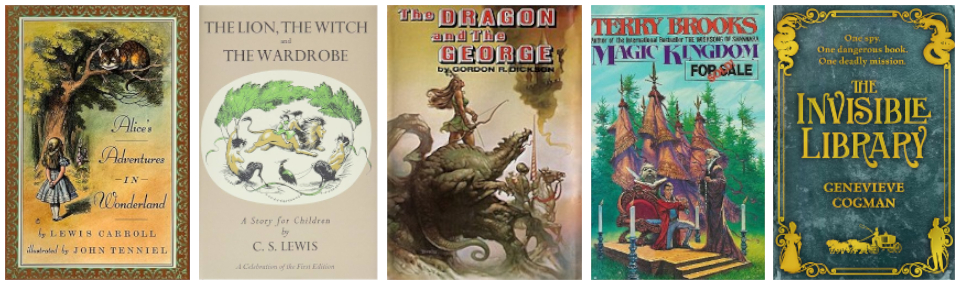
Such as a wardrobe that takes one to a land fought over by a talking lion and a witch. The Lion, the Witch, and the Wardrobe (1950) by C.S. Lewis is a classic example of portal fantasy, and considered by many to be the progenitor of the genre as we know it today. Predating this, and perhaps an influence on it, was the Victorian children’s story Alice’s Adventures in Wonderland (1865) by Lewis Carroll, in which the titular character goes down the literal rabbit hole (which is the origin of the proverbial one) into a strange, fantastic realm. A favorite of mine is The Dragon and the George (1976) by Gordon R. Dickson, about a history professor in Minnesota whose mind is projected into the body of a dragon in a fantasy world. Another great example of the genre is Magic Kingdom for Sale—Sold! (1986) by Terry Brooks, about a lawyer from Chicago who buys a fantasy kingdom connected to our world by a magic mist. Finally, a more recent example of this genre is The Invisible Library (2014) by Genevieve Cogman, about a librarian tasked to travel to other realities to collect books.
Intrusion Fantasy
Standing in opposition to portal fantasy is intrusion fantasy (aka intrusive fantasy), in which elements of the fantastic encroach upon an otherwise normal Earth. This can be a transit from another world to ours in a literal reversal of the portal fantasy trope, or it can be something that lies on the fringes of our reality, hidden within it, or existing parallel to it. What these things are varies and could include a fantasy princess suddenly appearing in downtown Manhattan, monsters secretly stalking dark alleys, or fae creatures crossing the veil between worlds. Also, the incursion might be something more esoteric, like some sort of magical force leaking into our world from the beyond. Intrusion fantasy may also revolve around supernatural beings exerting influence on the mortal world.
There are a lot of different approaches to intrusion fantasy. In Good Omens (1990) by Terry Pratchett and Neil Gaiman, an angel and a demon try to stop the antichrist from ending the world. Storm Front (2000) by Jim Butcher follows a wizard who is also a detective and monster hunter in modern Chicago. In a similar approach, Rivers of London (2011) by Ben Aaronovitch shows a police detective working for a special branch investigating magic and supernatural cases. The Night Circus (2011) by Erin Morgenstern keeps the intrusion small and focused when a magical traveling circus suddenly appears out of nowhere. Finally, The Raven Boys (2012) by Maggie Stiefvater mixes the supernatural and magical when ghosts help a clairvoyant girl peel away the layers between our world and what lies beyond.

Contemporary Fantasy
Contemporary fantasy is a type of fantasy story which takes place in our world in an era contemporary (in the same time period) to the author. Being such a broad definition, many other subgenres of low fantasy fit onto this shelf as well. Most of the examples for intrusion fantasy, above, do just that. Contemporary fantasy stories might also explore a version of Earth where magic is commonplace, breaking away from intrusion or portal fantasies. The main thing here is the time period, making this a relatively large box that has plenty of room for smaller boxes like our above examples and other subgenres such as urban fantasy to share space inside it.
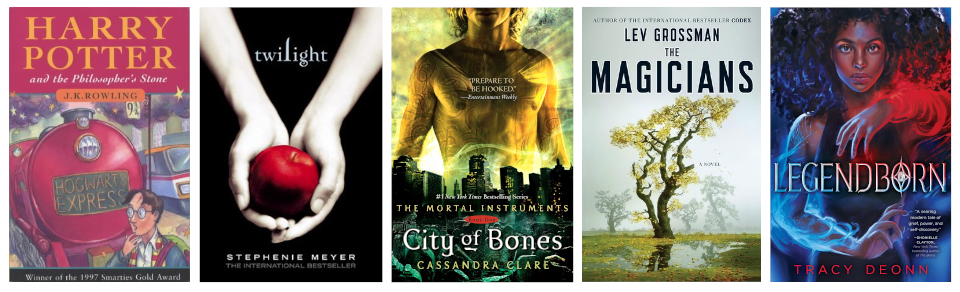
Likely the most well-known example of contemporary fantasy is the Harry Potter series by J.K. Rowling, starting with Harry Potter and the Philosopher’s Stone in 1997, in which magic is and has always been part of our world, although it is kept secret from the general populace. Twilight (2005) by Stephanie Meyer is another good example of fantasy elements being part of our reality, as vampires exist and always have in this book and its sequels. City of Bones (2007) by Cassandra Clare is a good example of a contemporary fantasy that could also be considered intrusion fantasy, as a secret organization able to see demons fight to protect the world from them. A great example of blending genres is The Magicians (2009) by Lev Grossman, which presents a contemporary fantasy where magic is real, explores intrusion fantasy as outside forces threaten our world, and branches into portal fantasy when the protagonists travel to a fantastic realm. Finally, another popular book where magic is part of our reality is Legendborn (2020) by Tracy Deonn.
Historical Fantasy
Similarly broad as contemporary fantasy, historical fantasy explores what our past might have been like with fantastic elements added in. This should not be confused with alternative history—which sticks to realistic elements but changes the course of events, or historical fiction—which dramatizes true history or uses a historical setting as a backdrop for a personal story that doesn’t alter events. Historical fantasy can cover any era, from prehistory to the recent past. Some sub-subgenres of fantasy are specific to certain periods, such as flintlock fantasy and gaslamp fantasy, and may fall under historical fantasy or high fantasy depending on if the setting is a historical era on Earth or a secondary world inspired by a historical era.
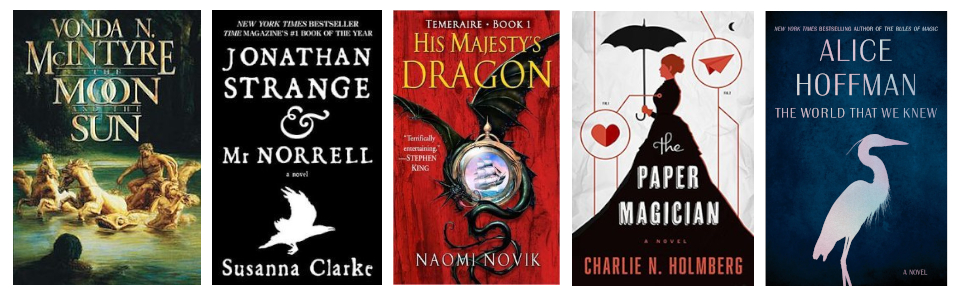
The Moon and the Sun (1997) by Vonda N. McIntyre is one such example of historical fantasy which proposes a seventeenth century France where sea monsters are real. A great example of Victorian fantasy or gaslamp fantasy, Jonathan Strange and Mr. Norrell (2004) by Susanna Clarke tells a tale of two magicians in early-nineteenth-century England. A fascinating flintlock fantasy series that isn’t afraid to go big is Temeraire by Naomi Novik, with nine novels and a collection of short stories. The first book, His Majesty’s Dragon (2006), thrusts us into an alternate Napoleonic Wars with dragon riders. A novel which tosses magic into a historical setting is The Paper Magician (2014) by Charlie N. Holmberg, set in an alternate 1902 where magicians can manipulate certain elements or materials. Finally, The World That We Knew (2019) by Alice Hoffman is a touching story of a Jewish mother having a golem created to protect her daughter as they flee Germany in 1941 (this last example is also considered magical realism, which is a topic I will cover soon).
The Rising Popularity of Low Fantasy
Low fantasy titles have become widely popular in the twenty-first century, possibly toppling high fantasy from the dominance it enjoyed in the latter half of the twentieth century. The plethora of films and television series being made based on these works is testament to its popularity. There could be many reasons why this is. I’ve heard readers say they’re tired of the same old Tolkienesque, European medieval fantasy, so oversaturation and burnout might play a role. Popular preferences in art also change with time (consider how fast popular music changes), so modern markets may simply be more interested in grounded storytelling approaches. I think one of the huge draws of low fantasy is that it does something that another popular genre, science fiction, also does exceptionally well: it asks, “What if?” While high fantasy can take us on an adventure in a totally new world, low fantasy can pick apart our reality and explore what it might be like if the fantastic were real. This relatable, close-to-home approach might be what makes this side of fantasy appealing to so many, whether it’s on the page or a screen.

In the final part of our exploration of fantasy literature, More Subgenres of Fantasy Literature, we’ll take a brief tour of even more fantastic subgenres, such as dark fantasy, grimdark, urban fantasy, paranormal romance, and flintlock fantasy.
The Complete Guide to Fantasy Literature
- The History of Fantasy Literature
- The Fantasy Divide: Low vs High Fantasy
- High Fantasy and its Major Subgenres
- Low Fantasy and its Major Subgenres
- More Subgenres of Fantasy Literature
 B.K. Bass, Author and Editor